

Today’s edition of Callaway Climate Insights is free for all our readers. We really want to bring you the best and latest in climate finance from around the world. Please subscribe now.

With luck the weather will be nice in Turkey next month as climate delegates from around the world arrive in Antalya for the United Nations’ annual climate summit, dubbed COP31. That’s about all they can hope for as the prospects for any meaningful progress in fighting global warming look dire before the conference even begins.
While optimists will point to soaring electric vehicle sales in Europe and booming growth in solar and battery power as renewables gain market share over fossil fuels, the actual process of governments acting to prevent global warming has stalled.
The UN last month declared that the Paris Agreement of 2015, which called for all countries to reduce emissions to keep average global temperatures from rising more than 1.5°F. above its pre-industrial era average has all but failed. And this past week the UK joined the European Union and U.S. in abandoning attempts to require strict climate risk reporting by the largest companies (see below).
The EU itself said in a pre-summit document that it sees “no scope” for new climate finance commitments this year at COP31, according to a report by Bloomberg. Instead, the bloc will focus on holding countries to existing commitments to mitigate further damage from global warming rather than reduce it. But that will be hard as the U.S. has withdrawn from the process and Germany, according to Bloomberg, is set to miss its spending targets on climate finance for the year.
That won’t stop tens of thousands of delegates from heading to Turkey for their annual gabfest. But unlike the atmosphere five years ago in Glasgow, Scotland, when a real sense of optimism and achievement was in the air, this year it’s more likely to be a feeling of collective gloom.
If you have ideas or suggestions for us, contact me directly at dcallaway@callawayclimateinsights.com.
Zeus: UK the latest financial regulator to abandon tough climate disclosure

. . . . At a time when big financial institutions are pulling out all the stops to improve their detection and measurement of climate risk, governments around the world are abandoning their responsibilities to small investors to regulate information about the rising costs of global warming, writes David Callaway. Despite the soaring insurance costs and loss of productivity caused by extreme heat, violent storms, flooding and wildfires this year, the push to mandate climate risk disclosure among public companies has lost its steam in the U.S. and now Europe. The latest regulator to step back from tough new disclosure rules is the UK’s Financial Conduct Authority, which instead opted this week for a “comply or explain” disclosure process among British public companies. These situations often result in bad outcomes for investors.
Thursday’s subscriber insights
Giant utility merger to be election issue in Virginia
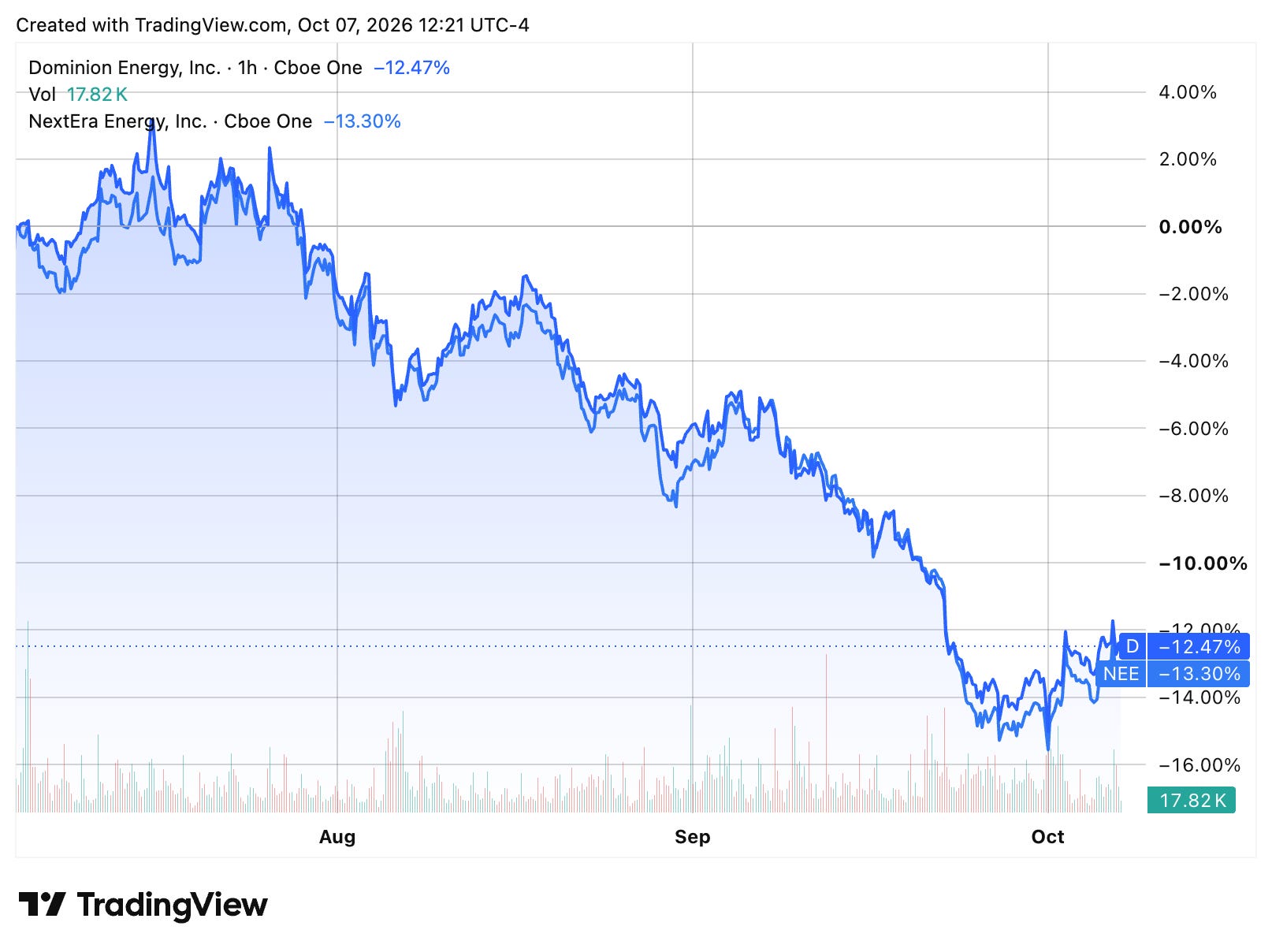
. . . . The $67 billion takeover of Virginia’s Dominion Energy D 0.00%↑ by NextEra Energy NEE 0.00%↑, announced earlier this year, is threatening to become a major election issue in Virginia as voters head to the polls next month.
Hailed as an important step toward energy grid improvement and consolidation in the Southeast when it was announced in May, the deal has instead fallen afoul of rising public concern about electricity prices and data center expansion in a state which boasts the most data centers in the country.
While Virginia’s State Corporation Commission is not scheduled to decide on whether to allow the deal to proceed until January, and it’s not expected to close until late 2027, the merger is now a political football in the state’s chaotic pre-election politics.
An early State Corporation Commission (SCC) hearing was scheduled for this week, and Virginia Gov. Abigail Spanberger has said she is skeptical of the merger and concerned about its impact on Virginia electric ratepayers, as well as the data center growth in the state. Lobbyists from both sides are pounding legislatures with arguments for and against, while investors wait on the sidelines.
NextEra’s shares have fallen more than 15% since the deal was announced in May. Dominion’s shares initially rose but have declined in the last month to a level below where they were in May. NextEra has lost out on two proposed takeovers of other utilities before, so losing Dominion would be a particular blow.
The real battle over whether the deal goes forward will take place after the midterms, but for the time being both energy companies will have to bear the brunt of some of the fiercest election politics in the nation.
Editor’s picks: Who’s paying for the power struggles?
Watch the video: Inside Climate reports this summer’s punishing heat waves have forced many people to run their air conditioners more frequently, causing utility bills to climb. U.S. residential energy costs have risen by 30% in the past five years as energy-hungry technology like AI and aging infrastructure add stress to an over-worked electric grid. The problem is particularly bad in Alabama, a state with high poverty rates and a utility with the highest average residential bills in the country. Lawmakers were determined to address the consumer impacts by overhauling the state’s public utility commission, but last-minute changes to the legislation handed more power to the governor to control how rates are set. It’s all happening at a time when data centers are coming to the state, with promises but little clarity about who will pay the bill for their enormous energy use.
Latest findings: New research, studies and projects

Penguin population collapse discovered on volcanic island
Climate-driven changes to the Southern Ocean have disrupted a critical food supply and resulted in the loss of over half a million chinstrap penguins from the Antarctic island of Zavodovski in the South Sandwich Islands. Researchers from British Antarctic Survey (BAS) say this loss represents more than a quarter of the island’s penguins, whose numbers are made up almost entirely of chinstrap and macaroni penguins. For years, the BAS says, Zavodovski Island appeared to buck the trend of widespread chinstrap declines reported across Antarctica and surrounding islands. But the new study, published Wednesday in the journal Current Biology, shows Zavodovski now has the highest rate of chinstrap population decline in the world. The South Sandwich Islands are home to 30% of the world’s chinstrap population. The declines here, along with those seen elsewhere in Antarctica, may tip chinstrap penguins into the Endangered category on the IUCN Red List of Threatened Species. Prof. Norman Ratcliffe, penguin ecologist at BAS, who led the research, said, “This is a worrying decline for chinstrap penguins, which have specialist diets and specific ocean temperature preferences. Our tracking data shows they prefer to forage in cooler waters to the northwest of the island, where they would expect to find Antarctic krill — the prey that make up the bulk of their diet. The problem is, with waters warming, the krill have moved southwards into the Weddell Sea. Sea-ice cover to the south and a lack of suitable islands for nesting prevents chinstraps from following the food.”

Words to live by . . . .
“Life starts all over again when it gets crisp in the fall.” — F. Scott Fitzgerald.