

Today’s edition of Callaway Climate Insights is free for all our readers. We really want to bring you the best and latest in climate finance from around the world. Please subscribe now.
Bureaucracies are masters in obscuring what they’re trying to say behind legal and vague jargon, and none are better than French bureaucracies. Which is why at first glance the headline on the International Energy Agency’s 2026 World Energy Investment report released Thursday might seem so obvious. And boring.
Claiming the Middle East conflict this year will “reshape investment plans,” the Paris-based IEA seems to simply be rehashing what most energy analysts and journalists have been saying for months; that the Iran war disrupting the world’s oil supply chains will cause a shift to renewable energy such as solar and wind, and nuclear.
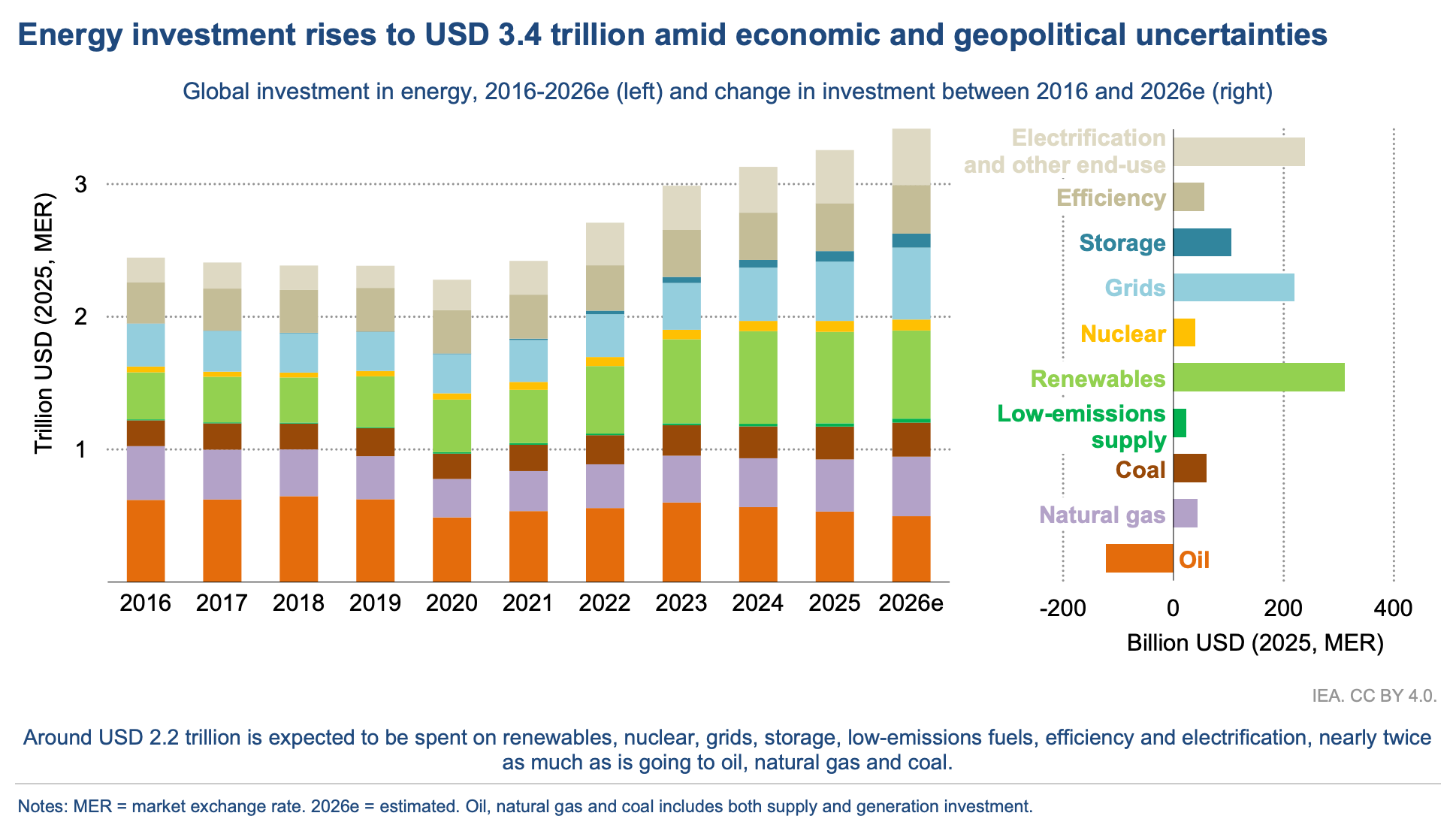
But down in the guts of the release the numbers and quotes tell a different story, one that portends a generational, permanent shift in how the world views the future of oil. Saying frankly that “we are in the midst of the largest energy crisis the world has ever faced,” IEA Executive Director Faith Birol introduces a set of numbers that make it difficult to see a way for oil investment to ever recover.
Of the $3.4 trillion the group projects will be spent on energy this year, only about a third will go to fossil fuels such as oil and gas and coal, while the rest will be spent on electric grids, renewable energy and clean fuels.
More specifically, oil investments will decline for a third year despite higher oil prices, falling below $500 million. Renewable energy investments will be more than $665 billion this year, with more than half of that ($365 billion) in solar alone, the IEA said. Meanwhile, nuclear continues to grow while the only fossil fuel showing any sort of gains is natural gas, because of its attraction to data center builders.
Even if the Iran war ends soon, the example it set of how critical supply chains can easily be choked off will linger long enough to prevent energy companies from shifting back to putting in the years and dollars it takes to develop new oil fields when there are other more profitable ways to generate electricity and meet the surging demand that energy security requires.
Most major financial crises and shifts in perception only become clear in hindsight, such as the change to energy supplies during the oil shock of the 1970s. What the IEA is trying to say here in this report is that this is one of those times. And it’s laying out the numbers to prove it. Investors just have to look.
Don’t forget to contact me directly if you have suggestions or ideas at dcallaway@callawayclimateinsights.com.
Follow us . . . .
Twitter | LinkedIn | Facebook | Instagram
Sounds of silence: Greenhushing now marks the most ambitious climate fighters

. . . . Five years after companies bragging about their environmental practices led to a controversy around “greenwashing,” some of the most active companies in fighting climate change are going the opposite way, not talking about their actions, writes Mark Hulbert. It’s called “greenhushing” and while it might be harder for investors to track down, the practice is associated with better performance by the stocks of companies who engage in it, according to a new study that Hulbert analyzes. There are several reasons companies are choosing not to promote their environmental accomplishments, including a hostile atmosphere toward climate change coming from the White House and negative press around greenwashing itself. According to Hulbert’s analysis of the study, it’s not how much you promote your climate actions that benefit your stock, but how much you actually walk the walk.
Thursday’s subscriber insights
How BP’s latest boardroom scandal inexorably leads back to climate
. . . . While it’s tempting to speculate that the sudden removal this week of BP Chairman Albert Manifold was simply a targeted kneecapping by new CEO Meg O’Neill to remove an obstructive board leader, the background of Manifold’s role in pushing the oil giant away from the green goals of its recent past deserve scrutiny.
Manifold said Wednesday that he would dispute the characterization by the company that he had committed grave corporate governance offenses. Former employees told journalists he was an abrasive leader given to tantrums and bullying of subordinates. While this is repulsive, it’s fairly common in corporate life. Some of the famous CEOs in history in the UK and elsewhere fit that mold.
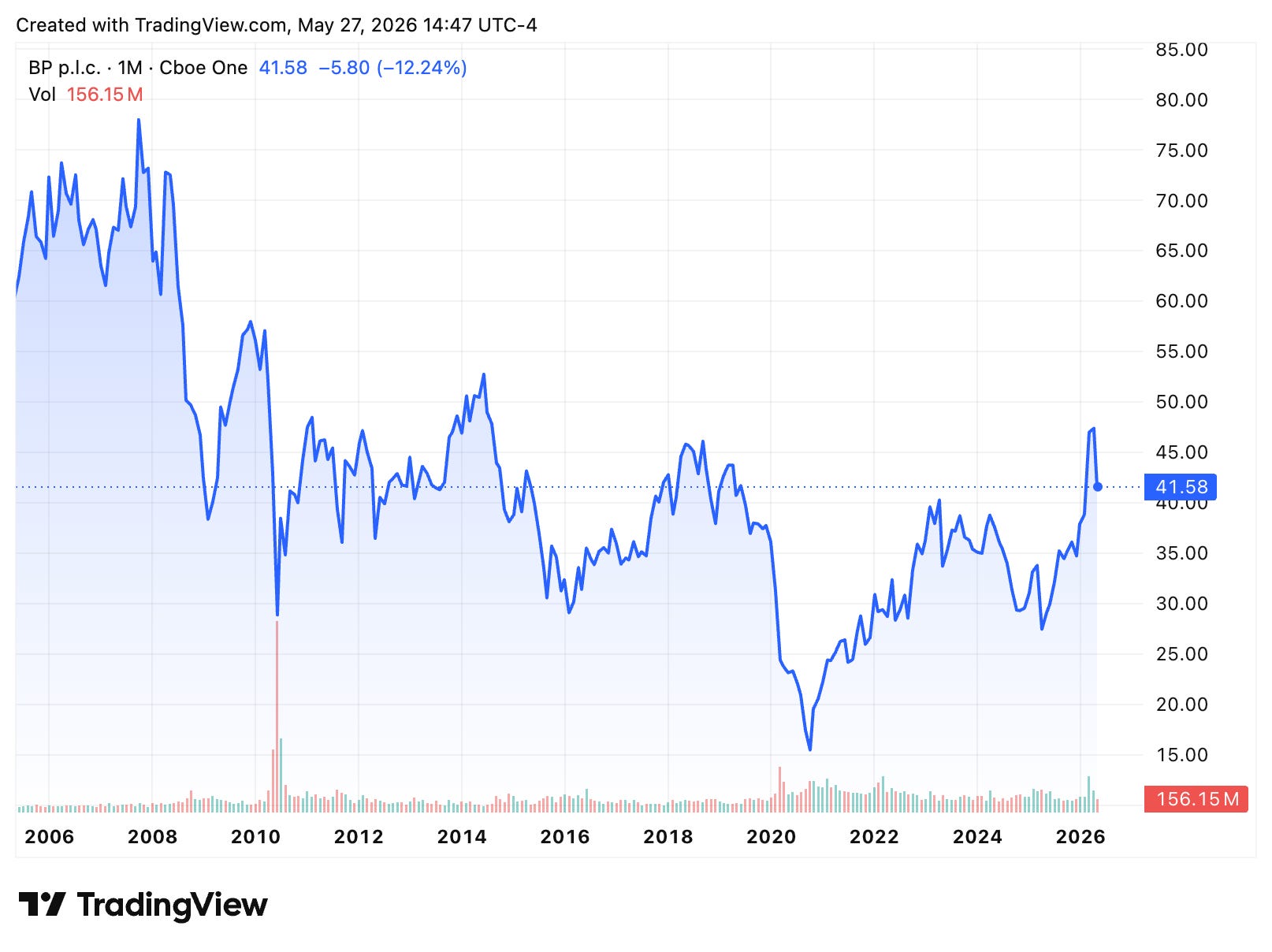
BP BP 0.00%↑ investors went a bit deeper, noting that Manifold was brought in only nine months ago to help with its shift back to traditional oil and gas from the renewable goals of previous leadership. His tactics were divisive, in particular when he managed to shelve attempts by shareholders this spring to include a resolution on climate for vote at the company’s annual general meeting, saying it had not been filed correctly. As a result, as much as 20% of shareholders voted against his election to the board at the meeting.
No doubt his removal was prompted by a combination of things, some of which we still may not be aware of. Perhaps O’Neill, who comes from an energy background, will have a better understanding of where BP fits within the giants of the oil and gas industry and the impending challenges of an energy crisis and climate change.
Either way, the ouster represents just the latest scandal at a company that can’t seem to avoid controversy long enough to show results, confounding shareholders for more than 20 years now.
Editor’s picks: Europe’s deadly heat dome; plus, new turbines, more hydropower
Watch the video: France and the United Kingdom are currently being roasted by a heat dome, driving up temperatures in western Europe. Although the phenomenon is common, it is now being exacerbated by climate change. It’s the same mechanism that has been affecting India for weeks, with temperatures exceeding 113°F in some places, and led to wildfires in Canada in 2021.
Hoover Dam to get new turbines
The U.S. Bureau of Reclamation will provide $52 million to replace three old turbines at Hoover Dam amid worries about cuts to hydropower for water users in Nevada, California and Arizona. The Las Vegas Review-Journal reports the agency previously warned extremely low reservoir levels could cause a 40% reduction in hydropower. Forecasters said water levels in Lake Mead levels could plunge to historic lows over the next two years. Older turbines cannot generate power below 1,035 feet in elevation at the reservoir, and hydropower levels would have dropped from 1,302 megawatts to 382 megawatts, the agency said. The three new, wide-head turbines could restore at least 160 megawatts of hydropower capacity, according to a news release.
Latest findings: New research, studies and projects

Climate change and salmonella threats
Climate change is linked to rising antibiotic resistance in salmonella, one of the world’s most common bacterial diseases. A new study, led by researchers from the UK, France, Australia, Switzerland and China and published recently in The Lancet, says “warming and shifting precipitation patterns are associated with rising antimicrobial resistance gene (ARG) abundance and are projected to further exacerbate antimicrobial resistance (AMR) risks under high-emission scenarios.” Antibiotic resistance is one of the fastest-growing threats to global health. The Guardian reports. It can affect people of any age in any country and already kills more than 1 million people a year, according to estimates. According to the report, the main drivers of antibiotic resistance are the misuse and overuse of antibiotics. The research signals the problem is being worsened by climate change. “The accumulated evidence suggests that climate change is an accelerating force behind the global spread of antimicrobial resistance,” the authors write.

Words to live by . . . .
“We are all children of one great mother, Nature.” ― Charles Dickens.